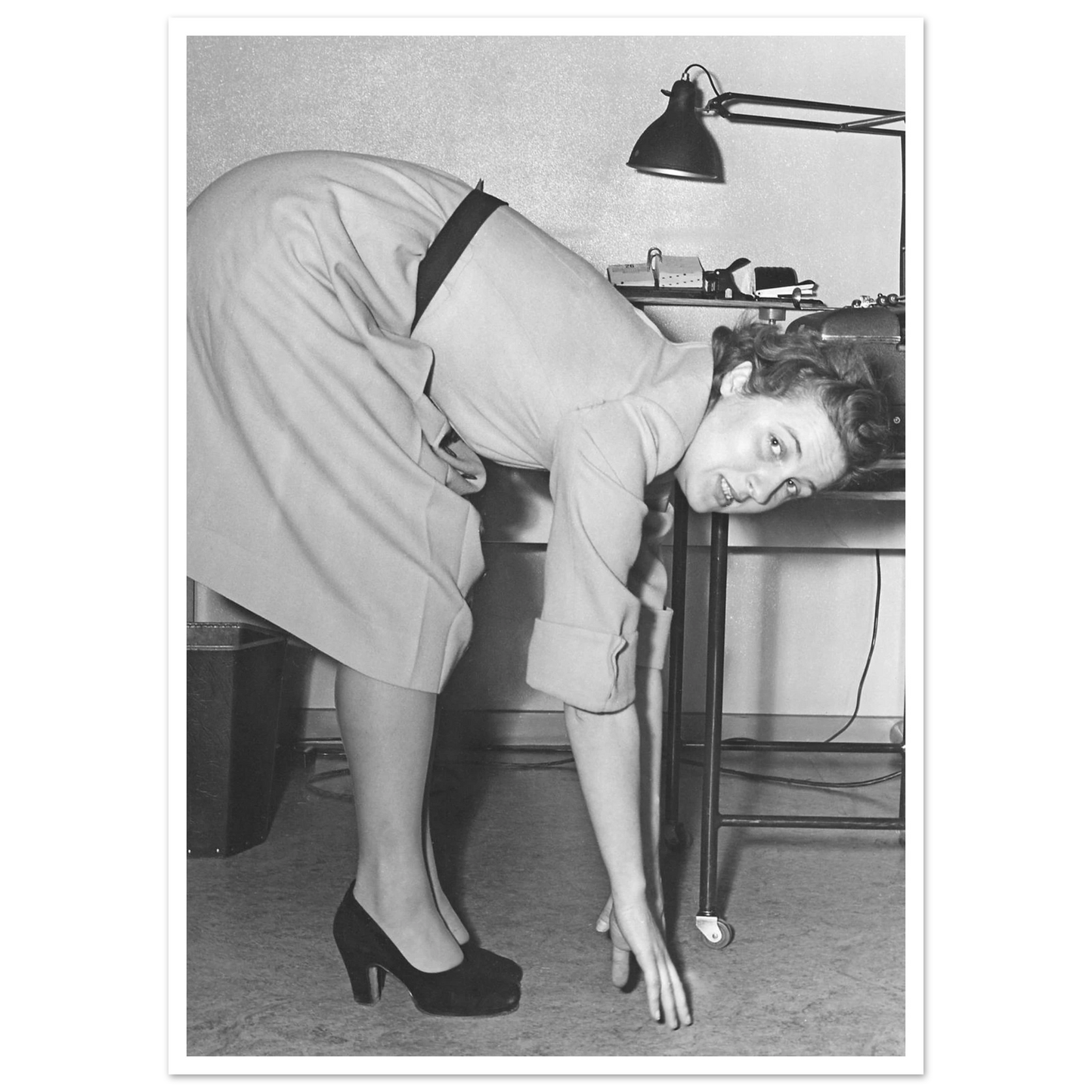
Sjöberg Bildbyrå Fotograf Kristoffersson
Office Gymnastics 1949 - Premium poster with matte paper
Choose whether you want to order the image printed within a white frame or as a full-bleed image. Depending on the format, the image may be cropped differently.
Regular price
€44,95 EUR
Regular price
Sale price
€44,95 EUR
Unit price
per
Tax included.
Shipping calculated at checkout.
Couldn't load pickup availability
Poster with a picture of Mrs. Ulla Klingström, an employee at the company Thulebolagen, when she participates in office gymnastics on the premises.
Office Exercise in the 1940s: A Movement for Health and Efficiency
Office gymnastics, or break gymnastics, is a form of short, organized physical activity performed in the workplace to promote health, reduce stress, and increase productivity. In the 1940s, the phenomenon became particularly prominent in many countries, including Sweden, where it gained a clear place in working life, especially within office environments.
The occurrence in the 1940s
During the 1940s, working life was characterized by an increased awareness of ergonomics and health, partly driven by industrialization's demands for efficiency and a healthy workforce. Office gymnastics was introduced as a way to counteract the physical and mental strain that long working days at a desk brought. In Sweden, where the welfare state was beginning to take shape, it was seen as part of a broader public health effort. Companies and authorities encouraged short gymnastics sessions, often led by an instructor or via radio programs, where employees performed movements such as stretches, push-ups and light bends directly at the workplace.
Break gymnastics was particularly common in the Nordic countries and Germany, where employers saw it as an investment in the health of their staff. In Sweden, radio programmes such as "Morning Gymnastics" and similar programmes were broadcast, encouraging both office and factory workers to participate. During the war years, when resources were scarce and the workforce needed to be kept healthy, these programmes became particularly important.
Importance
The importance of office gymnastics lay in its dual purpose: to improve physical health and increase work productivity. Sitting for long periods of time led to problems such as back pain, stiffness and fatigue, which could reduce efficiency. By introducing short breaks with movement, employers were able to reduce sick leave and improve staff well-being. At the same time, the community in the workplace was strengthened, as gymnastics was often performed in groups, which created a sense of belonging.
During the 1940s, physical activity was also seen as a moral and patriotic act, especially in times of war. In many countries, including Sweden, health was linked to the strength of the nation, and office gymnastics became a way to contribute to this ideal. For women, who increasingly took up office work during the war, gymnastics also became a way to promote a healthy lifestyle at a time when they were expected to take on new roles.
Odd facts
- Radio-controlled gymnastics : In Sweden, break gymnastics was often broadcast over the radio, where a voice guided office workers through movements such as "stretching the back" or "rolling the shoulders." This was especially popular during the 1940s, when radio was a central medium.
- Uniform movements : In some countries, such as Germany, office gymnastics was highly standardized and sometimes militaristic inspired, with precise movements to be performed in synchronization.
- Fashion and gymnastics : Women were sometimes encouraged to perform gymnastics in skirts and low-heeled shoes, which could make some exercises impractical. This reflects the strict dress codes of the time.
- Humor and resistance : Not everyone was enthusiastic. Some employees found the break gymnastics ridiculous, calling it "office dancing" or "gym farce." There were even cartoons in newspapers mocking the sometimes overly enthusiastic instructors.
Summary
Office gymnastics in the 1940s was more than just a physical activity – it was part of a larger movement to improve public health and the efficiency of working life. Through radio programs and group efforts, it became a natural part of many office environments, especially in the Nordic countries. Its importance lay in counteracting the negative effects of sitting still and strengthening work morale, while at the same time reflecting the social ideals of the time. The odd elements, such as radio-controlled workouts and dress codes of the time, provide a fascinating insight into what working life and health thinking looked like over 80 years ago.
Our premium quality, heavier, white, matte paper has a natural, smooth, uncoated finish that feels luxurious to the touch.