Sjöberg Bildbyrå AB
Piccadilly Circus 1934 - Premium poster with matte paper
Choose whether you want to order the image printed within a white frame or as a full-bleed image. Depending on the format, the image may be cropped differently.
Regular price
€44,95 EUR
Regular price
Sale price
€44,95 EUR
Unit price
per
Tax included.
Shipping calculated at checkout.
Couldn't load pickup availability
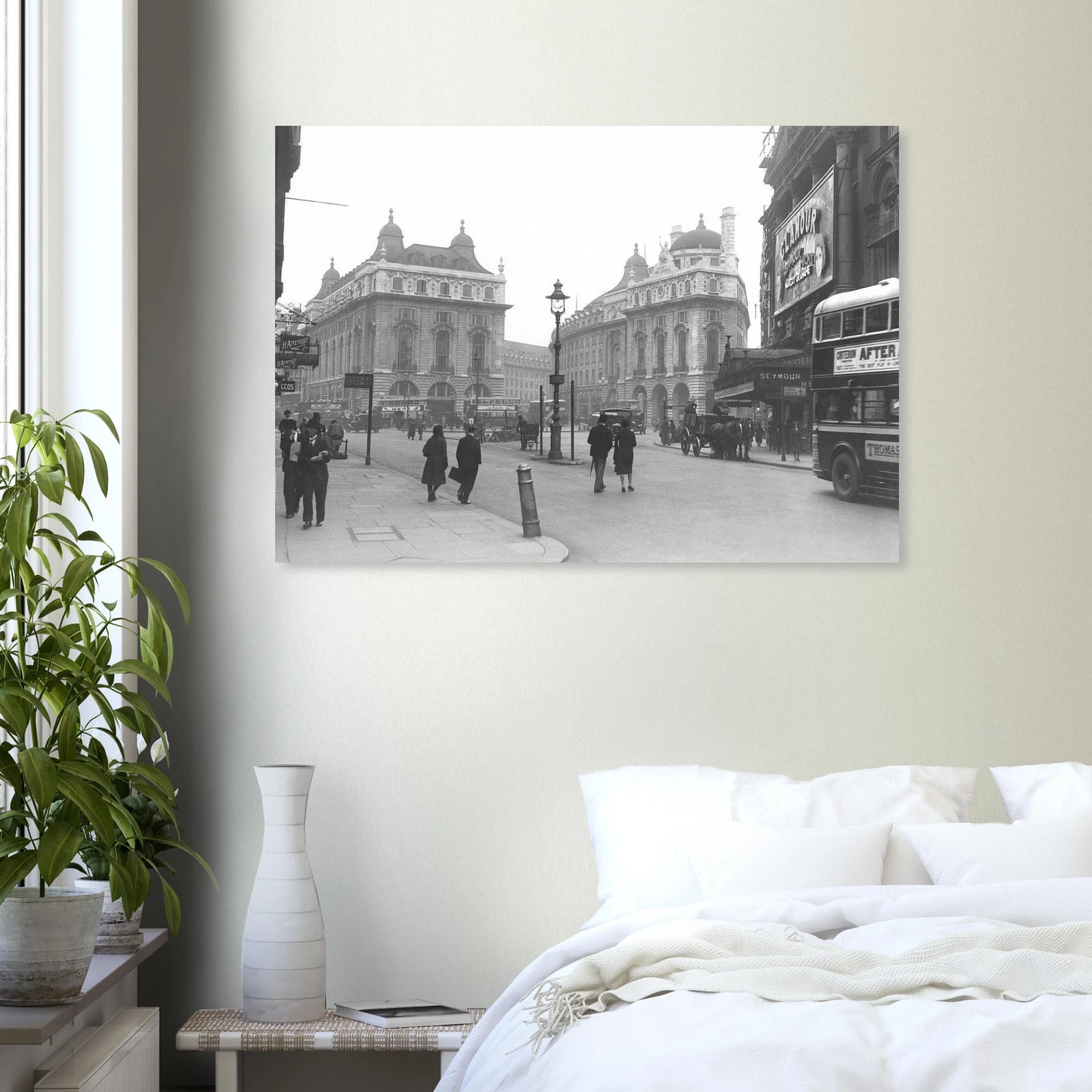
Poster with a picture from Piccadilly Circus in London in 1934.
This image of Piccadilly Circus in London in 1934 captures a bustling scene in the heart of the city, a place that was already one of London's most iconic hubs. Piccadilly Circus is a large roundabout where several famous streets meet, including Regent Street, Piccadilly, Shaftesbury Avenue and Haymarket. The area is known for its large advertising billboards, theatre district and as a central meeting place for Londoners and tourists alike.
The picture shows the grand buildings surrounding the roundabout, with their typical Georgian and Victorian architecture. A cinema is advertising the film Glamour, an American romantic drama film directed by William Wyler, which was released in 1934. Cinemas showing international films were common in the West End, where Piccadilly Circus is located, as the area was a centre for entertainment. Shaftesbury Avenue, visible in the background, was and still is famous for its many theatres, such as the Criterion Theatre, which attracted large crowds for evening shows.
The traffic in the picture shows a mix of old and new, typical of 1930s London. Horse-drawn carts, used for goods deliveries, coexist with motor vehicles such as the classic double-decker buses. The buses, marked "Thomas", are an early version of London's red buses, operated by London Transport, which was formed in 1933 to coordinate the city's public transport. Piccadilly Circus was a major hub for bus routes that transported people to different parts of the city.
The streets are filled with pedestrians, many dressed in period clothing such as hats and coats, reflecting the fashions of the 1930s. The pavements are wide and lined with lampposts, which were common to illuminate the area in the evening, especially given its lively nightlife. Piccadilly Circus was already famous for its neon signs, although in black and white they do not appear as clearly here. The statue of Eros, which is usually a central point of the roundabout, is not visible from this particular angle, but it has been in place since 1893 and was a popular meeting place.
During the 1930s, Piccadilly Circus was not only a commercial and cultural venue but also a symbol of London's modernisation. At the same time, the city was facing economic challenges following the Great Depression, which meant that street musicians, vendors and newspaper announcers were common features in the area. Despite this, Piccadilly Circus continued to be a place of glamour and entertainment, just as the cinema's advertisement for Glamour suggests.
Piccadilly Circus in London was described as the "Hub of the World" and this can be interpreted both literally and symbolically. The phrase "Hub of the World" is used to describe a place that acts as a central point where people, ideas, culture and commerce meet - a place that pulsates with life and importance.
For Piccadilly Circus in 1934, when the photo was taken, the description fits perfectly. The area was one of London’s busiest hubs. It was not only a geographical center but also a cultural and commercial center. People from all walks of life – Londoners, tourists, theatergoers and business people – gathered here, making the place a melting pot of different influences. Cinemas, like the one advertising the film Glamour in the photo, and theaters along Shaftesbury Avenue attracted people for entertainment, while the large advertising billboards and luxury shops along Regent Street and Piccadilly symbolized modernity and consumerism.
The term "hub of the world" can also be linked to London's role as the heart of the British Empire during the 1930s. Piccadilly Circus, with its international character, represented a world in miniature: buses and horse-drawn carriages ferried people to and from the site, international films were shown, and people from different parts of the world met here. The place was a symbol of London's global influence and its position as one of the world's leading cities.
At the same time, the expression captures a sense of timelessness. As early as 1934, Piccadilly Circus was seen as a place that never sleeps, where something was always happening – a quality that still characterizes the area today. "The Hub of the World" thus emphasizes both its practical function as a gathering point and its symbolic role as a place where the pulse of the world could be felt.
Our premium quality, heavier, white, matte paper has a natural, smooth, uncoated finish that feels luxurious to the touch.