Sjöberg Bildbyrå AB
Riddarhuset and Riddarhustorget 1902 - Premium poster with matte paper
Choose whether you want to order the image printed within a white frame or as a full-bleed image. Depending on the format, the image may be cropped differently.
Regular price
€44,95 EUR
Regular price
Sale price
€44,95 EUR
Unit price
per
Tax included.
Shipping calculated at checkout.
Couldn't load pickup availability
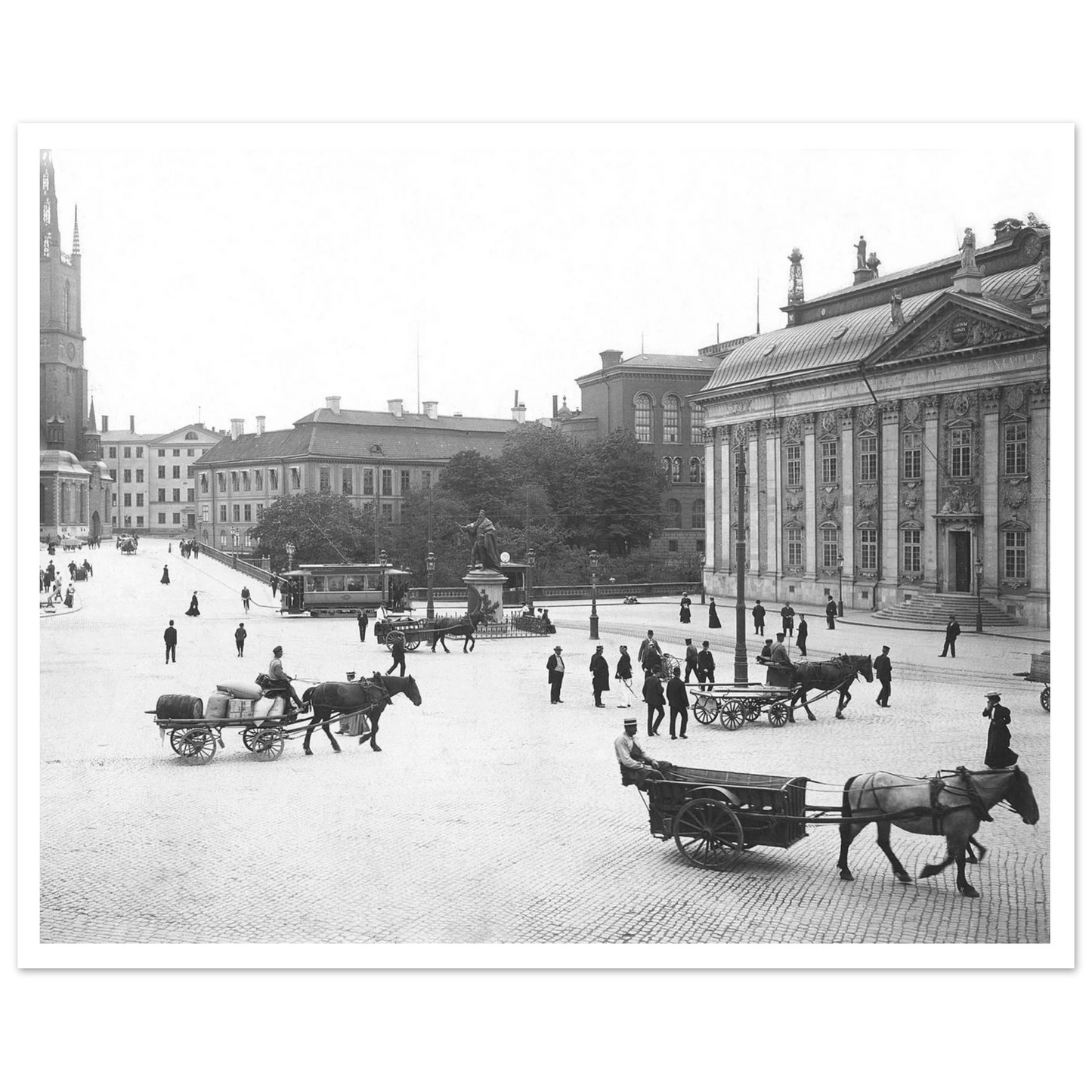
Poster with a picture of Riddarhustorget and Riddarhuset.
The year is 1902, and Riddarhustorget in the heart of the Old Town, Stockholm, is a lively intersection of history and everyday life. In the middle of the square stands the Riddarhuset, a Baroque building whose red-plastered facades and golden ornaments have witnessed centuries of Swedish history. Horses pull carriages, a tram is visible, and the Riddarhuset stands as a proud symbol of Sweden's noble past, while adapting to a modern era.
The Knight's House
The noble stronghold, the Knights' House, completed in 1675 to designs by architects Simon de la Vallée and Justus Vingboons, is one of Sweden's best-preserved Baroque buildings. Its purpose was to serve as the seat of the Swedish nobility, where the Knights' House as an institution organized the nobility's political and social influence. The building, with its symmetrical lines and magnificent interiors, is a display of power and prestige. Inside, the walls are adorned with over 2,300 coats of arms, one for each noble family, which together form a unique historical archive.
In 1902, the Riddarhuset was no longer the main meeting place of the Riksdag – the Riksdag moved to Helgeandsholmen in 1866 – but it is still a place for noble gatherings, ceremonies and administration. The Riddarhuset Order, which regulates the rights and obligations of the nobility, is still in force, even though the political power of the nobility has declined in step with Sweden's modernization.
Riddarhustorget
Situated between the Knights' House and the narrow alleys of the Old Town, 1902 is a lively place where Stockholm's different worlds meet. The cobblestones of the square bear the marks of countless footsteps, hooves and cart wheels. Here, farmers with carts full of goods and well-dressed city dwellers on their way to work or pleasure crowd. Horses pull carts in a city where the car is still a curiosity.
An early electric tram glides past in the background – a sign of Stockholm’s modernization. Introduced in the 1870s, trams are now an important part of the city’s infrastructure, and in 1902, electric trams begin to replace horse-drawn ones, marking a new era for the city’s transportation.
The square is not only a trading place but also a historical hub. It is located in the shadow of the Knights' Hall and close to other significant sites. The statue of Gustav Vasa, erected in 1774, stands as a reminder of Sweden's national heritage and the Reformation, and the square is still used for ceremonial events connected to the Knights' Hall.
In 1902, the Knights' House and Knights' Square stand in a fascinating period of transition. Once the center of Sweden's political life, the Knights' House has become more of a symbolic and administrative institution. The nobility still has influence, but industrialization and democratization have shifted power to new groups. The Knights' House, with its coats of arms and ceremonial traditions, is reminiscent of a bygone era, but it is also a place that adapts. The building is used for meetings, weddings, and other noble events, and its archives are an invaluable source for historians.
Our premium quality, heavier, white, matte paper has a natural, smooth, uncoated finish that feels luxurious to the touch.