Sjöberg Bildbyrå Erich Conard
Ulla Jacobsson She Danced One Summer 1951 - Premium poster with matte paper
Choose whether you want to order the image printed within a white frame or as a full-bleed image. Depending on the format, the image may be cropped differently.
Regular price
€45,95 EUR
Regular price
Sale price
€45,95 EUR
Unit price
per
Tax included.
Shipping calculated at checkout.
Couldn't load pickup availability
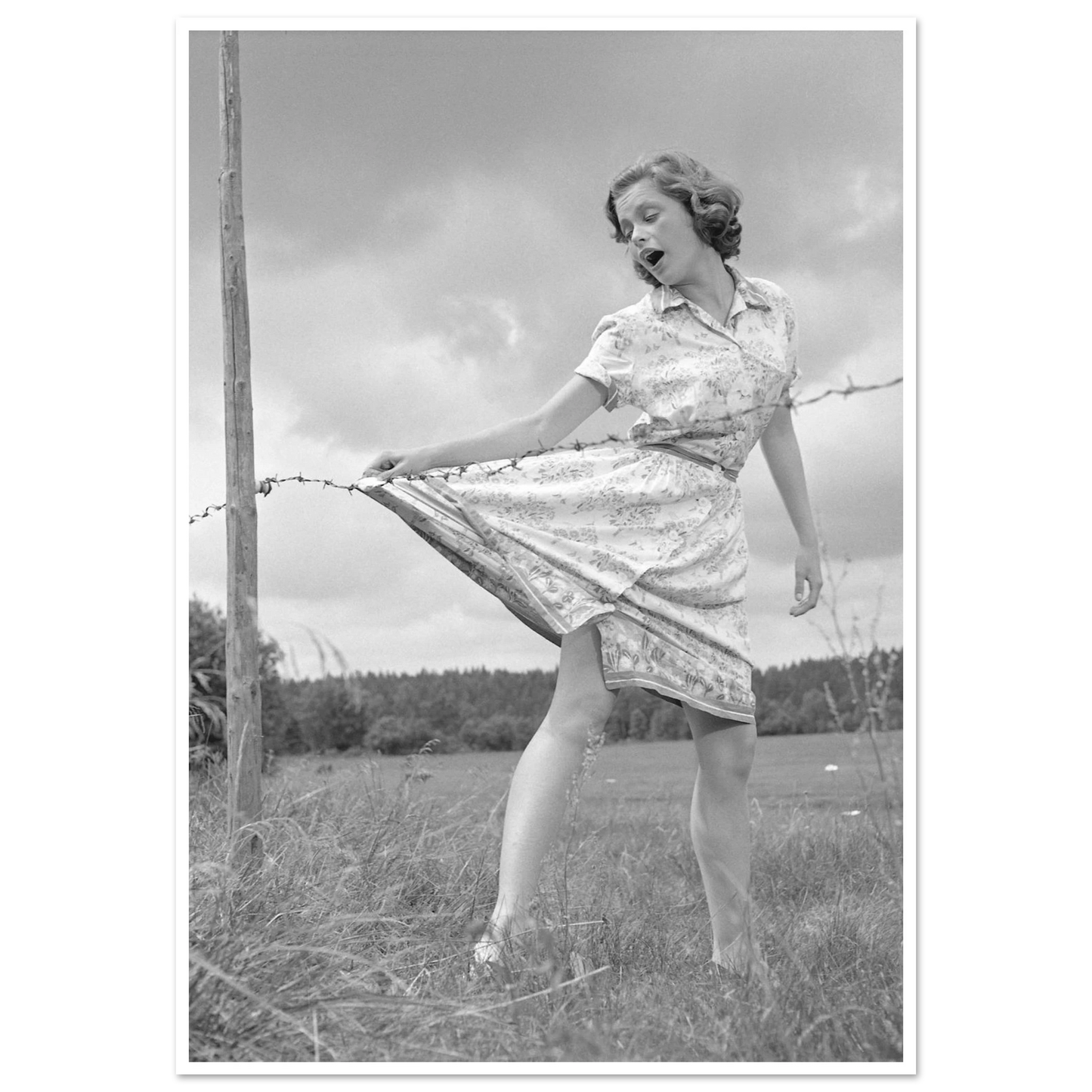
Poster with a picture of actress Ulla Jacobsson taken during the filming of the film She Danced One Summer in 1951.
She has her skirt caught in the barbed wire and is seen trying to get it free.
Ulla Jacobsson and "She Danced One Summer" – A Milestone in Swedish Popular Culture
Ulla Jacobsson (1929–1982) was a prominent Swedish actress whose role in the film She Danced One Summer (1951) not only defined her career but also became a defining event in Swedish film history and popular culture. Born in Gothenburg, Jacobsson began her career at the Gothenburg City Theatre before making her breakthrough on the big screen. Her performance in She Danced One Summer, directed by Arne Mattsson, made her an icon and contributed to the coining of the expression "the Swedish sin", which came to characterize the image of Swedish cinema internationally.
Ulla Jacobsson's performance in She Danced One Summer
In She Danced One Summer, based on Per Olof Ekström's novel Summer Play, Jacobsson plays the young Kerstin, a 17-year-old girl who experiences an intense and tragic love story with the farmer's son Göran (Folke Sundquist) during an idyllic Swedish summer. Jacobsson's portrayal of Kerstin is both sensitive and powerful, where she manages to convey a young woman's innocent passion, vulnerability and maturity in the face of the realities of life. Her natural acting and ability to balance innocence with a budding sensuality made the role memorable. The scene in particular where Kerstin and Göran bathe naked in a lake became iconic, not only for its beauty but also for its daring depiction of nudity, which was groundbreaking for its time.
Jacobsson's performance was praised for its authenticity, and her chemistry with Sundquist helped make the love story believable and moving. The film, which mixes romance with tragedy, was an immediate success in Sweden and won the Golden Bear at the 1952 Berlin Film Festival, bringing Jacobsson international attention. Her role in the film marked the start of a successful career, in which she later appeared in films such as Ingmar Bergman's The Smile of a Midsummer Night (1955) and international productions such as Zulu (1964).
The film's importance to popular culture
She Danced One Summer became a milestone in Swedish film history, not only for its artistic quality but also for how it shaped the perception of Swedish film and culture internationally. The film, with its poetic depiction of young love and its contrast with societal norms, captured a time when Sweden was beginning to emerge as a country with liberal values. The famous nude bathing scene, although relatively discreet by today's standards, was perceived as bold and provocative, especially abroad. This contributed to the film becoming a symbol of Sweden's supposed sexual liberation.
The phrase " the Swedish sin " was coined in the wake of films such as She Danced One Summer. The term, which was popularized internationally in the 1950s and 1960s, referred to a stereotypical image of Sweden as a country where sexuality and nudity were treated with an openness that was shocking to many conservative societies, especially in the United States and Britain. The film, along with later works such as Vilgot Sjöman's Jag är nyfiken – gul (1967), reinforced this image of Sweden as a place of sensual freedom. She Danced One Summer was not pornographic, but rather an artistic depiction of human relationships, but its international distribution and focus on nudity in marketing reinforced the myth of "the Swedish sin".
In Sweden, the film was seen as a beautiful and tragic love story, but abroad its sensual elements were exploited in advertising campaigns, reinforcing the stereotype. This made the film, and Jacobsson's role, part of a broader cultural discussion about morality, sexuality and artistic freedom. Although "the Swedish sin" was often an exaggerated and misleading image, it helped put Swedish cinema on the map and made Jacobsson a symbol of this era.
She became a role model for young independent women
She danced one summer and Ulla Jacobsson's performance had a lasting impact on popular culture. The film marked a shift in Swedish cinema from traditional narratives to more bold and realistic depictions of human emotion. Jacobsson's role as Kerstin became a model for later depictions of young, independent women in film. At the same time, the film helped to shape an international fascination with Swedish culture, even if it was often misunderstood.
The expression "the Swedish sin" became a cliché that both benefited and damaged the reputation of Swedish film. On the one hand, it attracted audiences to the cinemas, on the other hand, it reduced complex works to a simplified image of sensuality. Jacobsson herself navigated this stereotype by choosing varied roles in both Swedish and international productions, which shows her versatility as an actress.
In conclusion, Ulla Jacobsson's contribution to Hon dansade en sommar is a central part of the film's legacy and its role in shaping popular culture. Through her sensitive portrayal of Kerstin, she helped make the film a classic, while also inadvertently becoming part of the myth of "the Swedish sin". The film and Jacobsson's performance remain an important part of Swedish film history, both celebrating the beauty of love and challenging societal norms.
Our premium quality, heavier, white, matte paper has a natural, smooth, uncoated finish that feels luxurious to the touch.