Sjöberg Bildbyrå AB
Dock workers at M/S Gripsholm 1936 - Premium poster with matte paper
Choose whether you want to order the image printed within a white frame or as a full-bleed image. Depending on the format, the image may be cropped differently.
Couldn't load pickup availability
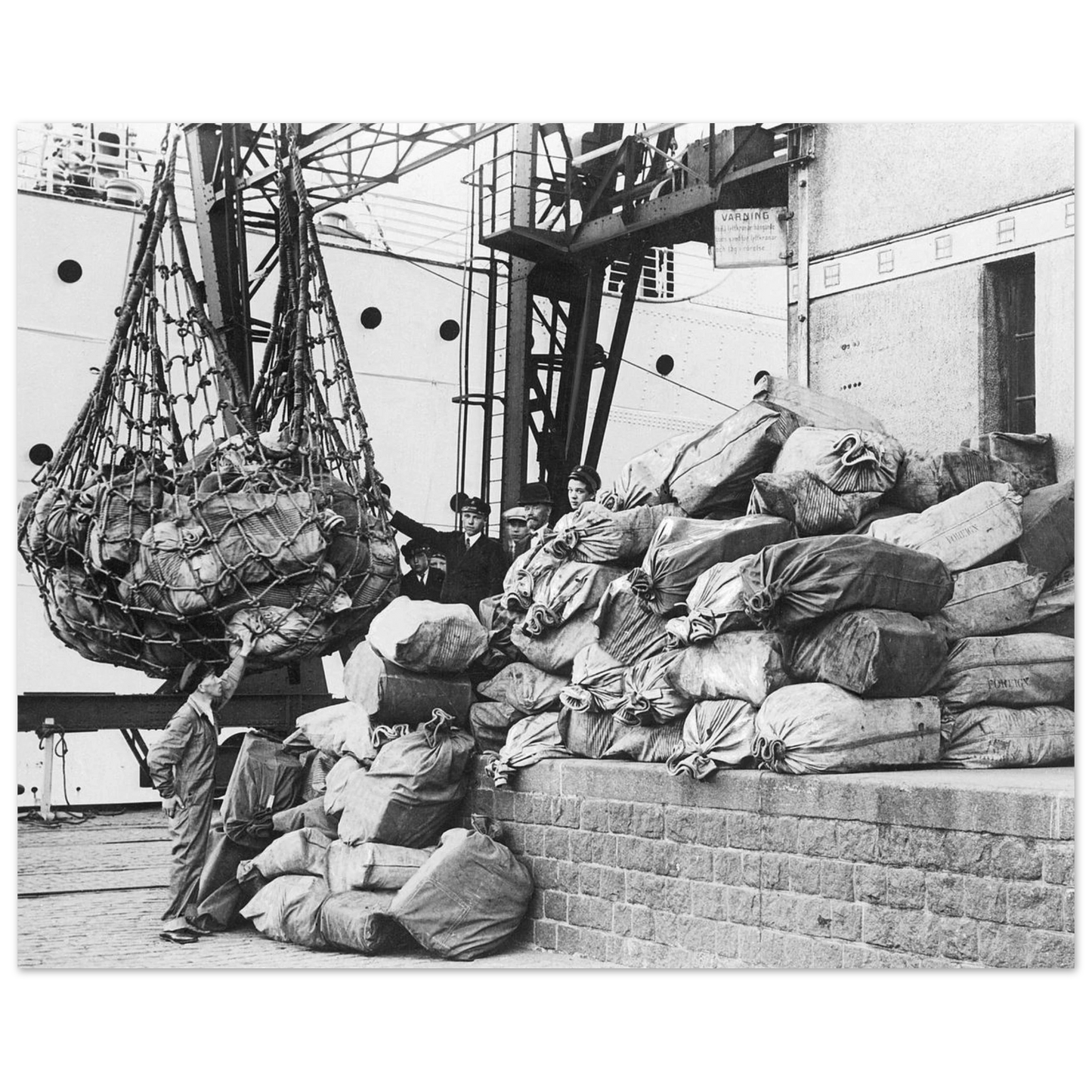
Poster with a picture of the ship M/S Gripsholm at the quay.
In 1936, the M/S Gripsholm, a proud ocean liner built in 1924 for the Swedish America Line, sails across the Atlantic between Gothenburg and New York. This image, taken at the quay, captures the ship’s importance in transporting mail and parcels – a lifeline of global communication before the dominance of aviation.
M/S Gripsholm and the importance of postal freight
Launched as the world’s first diesel-powered transatlantic passenger ship, M/S Gripsholm was not only a luxury passenger liner but also an important link for international mail and parcel freight. During the 1930s, shipping was the primary means of transporting letters, official documents and goods across the Atlantic. Gripsholm, with its reliable timetable and capacity to handle large volumes, played a key role in maintaining communication between Europe and North America. Mail and parcels, often containing everything from business documents to personal letters and product samples, were carefully stowed in the ship’s hold. Gripsholm’s fast crossings – around 10 days between Gothenburg and New York – made it a preferred choice for time-sensitive mail, strengthening Sweden’s role in transatlantic trade. The ship’s modern design and reliability helped Svenska Amerika Linjen become a trusted mail carrier, especially for emigrants sending letters and parcels between their old and new homelands.
In the picture we see dock workers in full swing unloading mail sacks from the M/S Gripsholm upon arrival at the port of Gothenburg. The mail sacks, often made of durable burlap and marked with destinations, are lifted from the ship’s hold by cranes or winches and then handled by hand. The dock workers, dressed in work clothes adapted for heavy work, organize the sacks on the quay for onward transport to the post office or railway. The work is done under time pressure, as the ship is only at the quay for a short time before the next leg. Their efforts are crucial to ensuring that the mail reaches its recipients without delay, and the scene in the picture shows an everyday but vital part of global logistics in the 1930s.
A break time for shipping and work
In 1936, M/S Gripsholm stands at the center of an era where shipping still dominates mail and parcel shipping, but where new technologies such as aviation are beginning to appear on the horizon. The image of dock workers unloading mail sacks captures a time when human labor is indispensable, but also a world moving toward mechanization. Gripsholm’s role as a mail ship and the port workers’ toil at the dock remind us of how crucial these ships and people were in keeping the world connected in an era before digital communication.