Sjöberg Bildbyrå AB
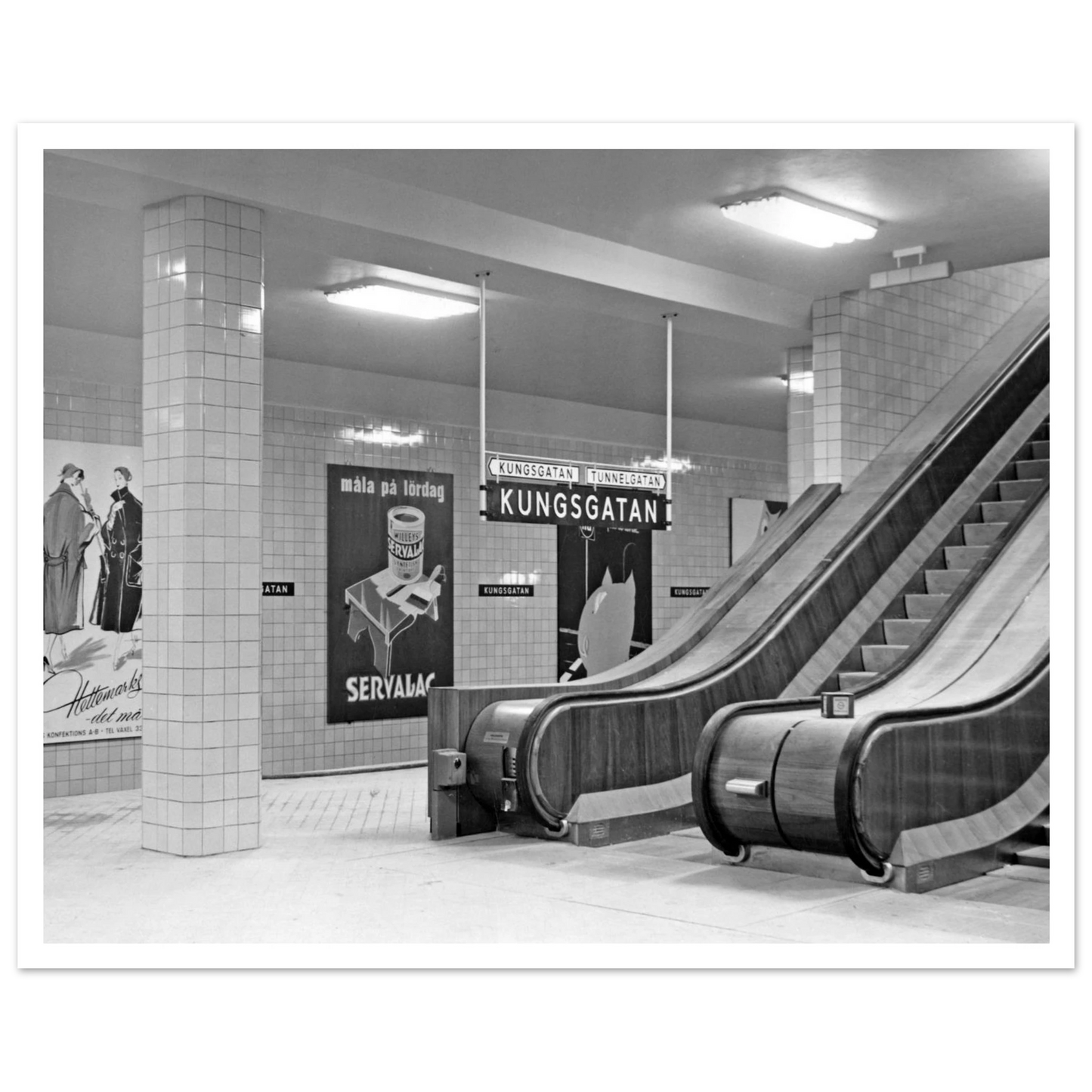
Kungsgatan, current Hötorget metro station 1952 - Premium poster with matte paper
Choose whether you want to order the image printed within a white frame or as a full-bleed image. Depending on the format, the image may be cropped differently.
Regular price
495 SEK
Regular price
Sale price
495 SEK
Unit price
per
Tax included.
Shipping calculated at checkout.
Couldn't load pickup availability
Poster with a picture from Kungsgatan, the current Hötorget metro station, 1952.
History and inauguration
Hötorget metro station, originally called Kungsgatan, is one of Stockholm's oldest metro stations and was inaugurated on 26 October 1952 as part of the first stage of the Stockholm metro network. The station was an important part of the section between Hötorget and Vällingby, which marked a significant expansion of public transport in Stockholm to meet the city's growing population and urbanization in the post-war period. The decision to build a metro in Stockholm had already been made in 1941, but it was not until the 1950s that the system began to take shape. Hötorget became a central hub on the Green Line, which then connected the inner city with the new suburbs to the west. The inauguration of the Hötorget–Vällingby section was a milestone, as it enabled fast and efficient transport to the new ABC city (Work, Home, City Centre) in Vällingby, a symbol of modern urban planning.
Lines at the inauguration
When it was inaugurated in 1952, Hötorget was served by the Green Line, specifically the Hötorget–Vällingby section, which was then part of what was called the Hässelbybanan. This line was partly built on a former tram line that was adapted for metro trains, without road crossings, and the route ran in a tunnel from Hötorget via Odenplan and on to Vällingby. In 1957, this line was connected to the Slussen–Hökarängen section via T-Centralen and Gamla stan, completing the Green Line's first continuous stretch through central Stockholm. At this time, Hötorget was one of the central stations in the growing metro network, serving both inner-city residents and commuters from the western suburbs.
Construction technology
Hötorget station is an underground station built using the so-called "cut and cover" method, a technique that was common during the 1950s subway construction in Stockholm. This method involved digging up streets, constructing a concrete tunnel with tracks, platforms and technical installations, after which the street was backfilled. For Hötorget, the tunnel was built under Sveavägen, which required extensive work and caused disruption to city traffic. The station is located relatively close to the ground surface, which is typical of early underground stations, and its construction was characterized by a simple, functional design. The construction process was documented, among other things, in a film about the subway construction between Hötorget and Fridhemsplan, which described how half a million tiles were used to cover the stations along this stretch.
Interior design and architecture
Hötorget station is a typical 1950s station, characterized by its simple and functional architecture. The station is clad in square, faintly blue-toned tiles, often described as "bathroom style", which was standard for early underground stations in Stockholm. This tile, together with the station's blue pillars, gives a period-typical 1950s atmosphere that has largely been preserved. Architecturally, Hötorget follows a uniform design that characterized the early stations, with a focus on functionality rather than aesthetic embellishments. The architect of the station is not specifically named in available sources, but Holger Blom, who designed the first underground stations such as Skanstull and Medborgarplatsen, may have had an influence on the early metro design. The station's original signs and waste bins from the 1950s are also preserved, which contributes to its historical character.
Art and decor
When Hötorget was inaugurated in 1952, the station lacked artistic decoration, which was typical of the earliest metro stations. It was only in the 1950s, after debates and motions in the Stockholm City Council, that art began to be integrated into the metro. As for Hötorget, it took until 1998 before the station received its artistic design. The artist Gun Gordillo then created a work consisting of 103 white neon loops on the ceiling, which run in different planes and give the station a modern and dynamic expression. This artwork contrasts with the otherwise simple tiles and reinforces the station's 1950s character without disturbing its original aesthetics. The neon loops are discreet but effective and have become a hallmark of the station. No other artists or additional works of art are specifically mentioned for Hötorget, which makes the station less ornate compared to later stations such as T-Centralen or Solna Centrum.
Summary
Hötorget metro station is an important part of Stockholm's metro history, inaugurated in 1952 as part of the Green Line between Hötorget and Vällingby. Hötorget is not only a transport hub but also an example of how the Stockholm metro developed from simple beginnings to become the world's longest art exhibition.
Our premium quality, heavier, white, matte paper has a natural, smooth, uncoated finish that feels luxurious to the touch.