Sjöberg Bildbyrå AB
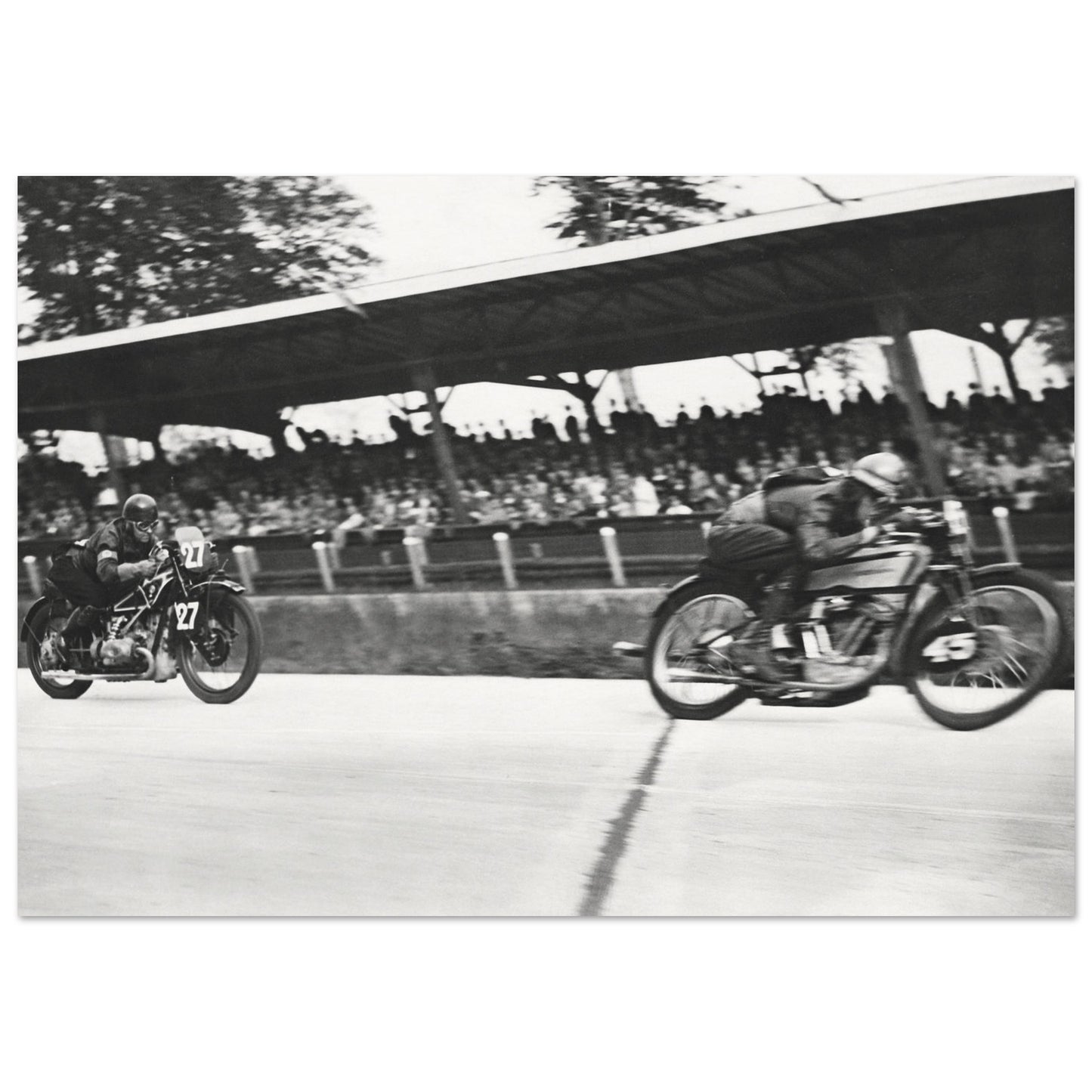
Motorcyclist Ragnar Sunnqvist 1935 - Poster on matte paper in museum quality
Choose whether you want to order the image printed within a white frame or as a full-bleed image. Depending on the format, the image may be cropped differently.
Regular price
495 SEK
Regular price
Sale price
495 SEK
Unit price
per
Tax included.
Shipping calculated at checkout.
Couldn't load pickup availability
Poster with a picture of the motorcycle racer Ragnar Sunnqvist in 1935 .
Ragnar "Ragge" Sunnqvist, born 11 August 1908 in Njurunda parish in Västernorrland county and died 17 November 1953 in Enskede parish in Stockholm, was one of Sweden's most prominent motorcycle racers during the 1930s. He became a legend in motorsport thanks to his bold riding style, technical skill and a series of impressive victories on international circuits. He is best known for his triumph in the German Grand Prix on the famous Avus circuit in Berlin in 1935, where he defeated German star Karl Gall on his number 45 500cc Husqvarna motorcycle and took home the victory in front of a record crowd.
Sunnqvist grew up with a passion for speed from a young age. His interest in motorsport was sparked early, and at the age of 16 he took a bold step by using his parents' chequebook to buy his first motorbike, a 125cc Evans, without their knowledge. He later upgraded to a 350cc Royal Enfield and at the same time began working as a mechanic in a motorcycle workshop, where he honed his technical skills. This combination of practical knowledge and competitive instinct laid the foundation for his future success.
His career took off in earnest in 1930 when he made his TT (Tourist Trophy, as road racing was then called) debut on a Norton in the Rasbo speed race outside Uppsala. Already at the age of 20 he showed signs of his talent, but it was when he joined Husqvarna in 1932 that his career exploded. Husqvarna-based Husqvarna was a leading player in motorcycle racing at the time, and Sunnqvist became a key member of their factory team along with star Gunnar Kalén. Together they formed a duo that dominated the racing scene and put Sweden on the map in the international motorcycle world.
Sunnqvist's first major international success came in 1932 when he won the Finnish Grand Prix in the 350cc class and the Swedish Grand Prix in the 500cc class at the Saxtorp circuit. That same year he impressed in his first major competition for Husqvarna, the Djurgårdsloppet in Helsinki, where he showed his capacity as a high-caliber rider. In 1933 the success continued with a victory in the Swedish TT in Hedemora in the 500cc class, and in 1934 he took another win on home soil in Saxtorp, this time on a lightweight Husqvarna weighing only 127 kg, developed by engineer Folke Mannerstedt.
The highlight of Sunnqvist's career, however, came in 1935 at the Avus circuit in Berlin. This race, the German Grand Prix, was the big event of the year and attracted 300,000 spectators as well as the best drivers from all over the world. With the number 45 on his 500cc Husqvarna, a machine he had fine-tuned himself with perfected carburetors and a top speed of over 200 km/h, Sunnqvist took the start. The German Karl Gall, on a fast BMW, offered stiff opposition, and the race developed into an intense duel. The two drivers exchanged the lead several times, but in the final north corner Gall took a gamble that went wrong – he had a dangerous wobble and lost control. Sunnqvist kept his nerves in check, passed Gall and crossed the finish line as the winner with an average speed of around 170 km/h – a remarkable achievement for his time.
The following year, 1936, Sunnqvist continued to reap success with victories in the French Grand Prix in Saint-Gaudens and the Italian Grand Prix in Monza, both in the 500cc class. He also participated in the Isle of Man TT for the first and only time, where he finished 17th in the 350cc class but was forced to retire in the 500cc race. His career was not only marked by road racing; Sunnqvist was a versatile driver who also competed successfully on ice tracks, grass tracks, hill climbs and in enduro. Among other things, he won the Nordic Championships in 1930, 1932 and 1934 and the Swedish Championship in 1936.
Sunnqvist was known for his fearless and risk-taking driving style, but also for his personality off the track. He is described as a colorful figure who loved to party, smoke cigarettes and make jokes – sometimes at the expense of motorsport journalists who had difficulty distinguishing his truth from his fiction. Despite his wild life, he was never seriously injured during his career, which is a testament to his skill and control.
After World War II, Sunnqvist made a sensational comeback, winning the C class at Skarpnäck in 1947, where he defeated several top European riders. His career spanned a decade and was marked by a unique combination of technical expertise, courage and an indomitable competitive spirit. Ragnar Sunnqvist passed away in 1953, but his legacy lives on as one of Sweden's most legendary motorcycle racers, and his Husqvarna from the Avus victory is preserved at the Husqvarna Factory Museum as a reminder of his heyday.
Our master's edition, off-white, archival, museum-quality paper is uncoated and a premium choice for art enthusiasts who appreciate world-class quality to enjoy artwork in the most luxurious way.