Sjöberg Bildbyrå Fotograf Roland Palm
Police Checkpoint 1958 - Premium poster with matte paper
Choose whether you want to order the image printed within a white frame or as a full-bleed image. Depending on the format, the image may be cropped differently.
Couldn't load pickup availability
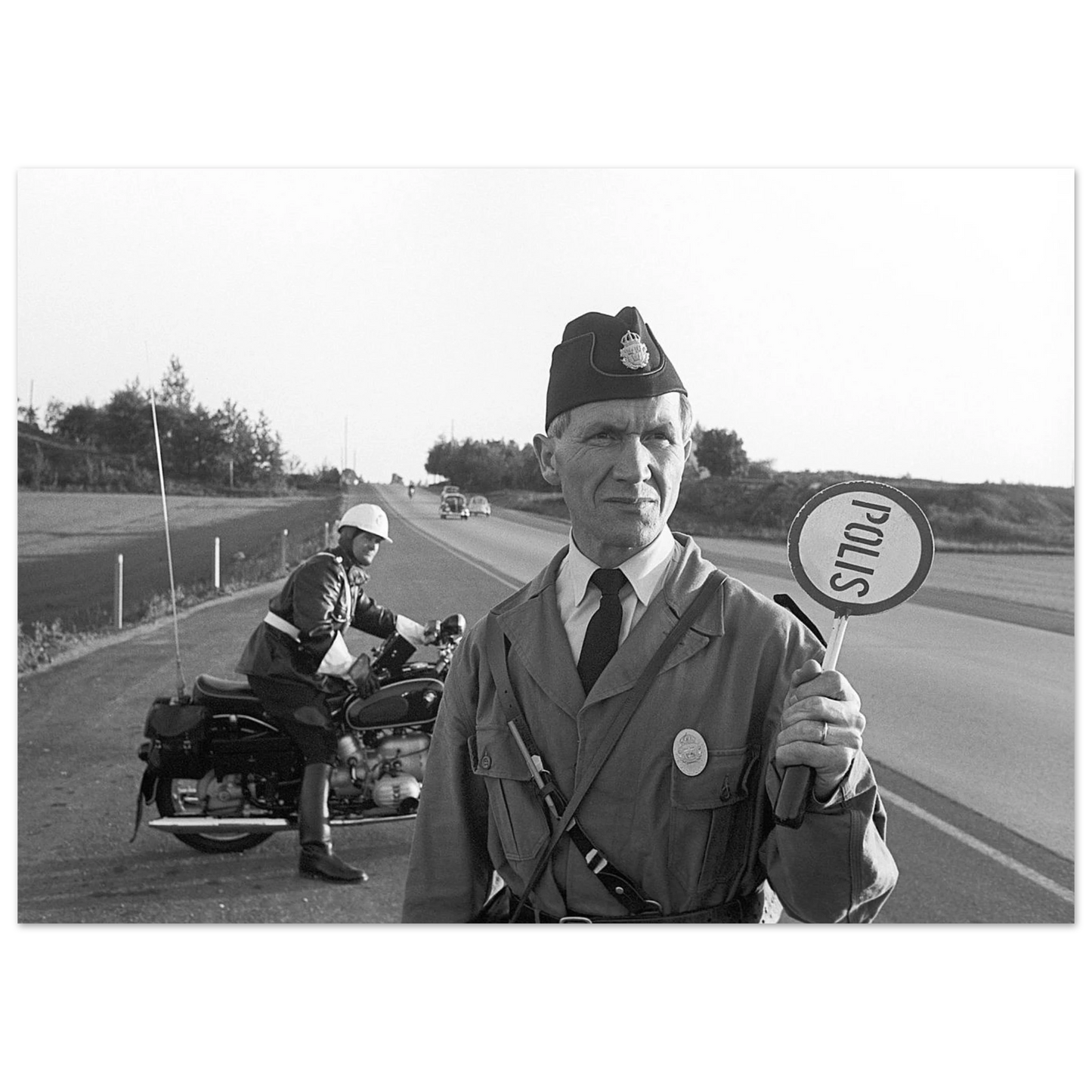
Poster with a picture of a police checkpoint on the Riksettan road.
Police checkpoint on the Riksettan road in 1958. National Road 1, better known as the Riksettan, was the main road between Helsingborg and Stockholm between 1945 and 1962, a stretch of approximately 570 kilometers that is now part of European Route 4 (E4). In the 1950s, the Riksettan was a busy artery for both cars, trucks and long-distance buses, but also a road where traffic rules and safety were beginning to receive increased attention. The road was often narrow, winding and ran through communities, which made traffic monitoring an important task for the police.
With a police shovel – a round, red and white sign with the text "POLIS" – a police officer stands at the side of the road, stopping cars to check driver's licenses, vehicle registration or speeding. Behind him stands a motorcycle police officer on a BMW motorcycle, ready to quickly move out if someone tries to evade the check. The motorcycle police, often equipped with a powerful Harley-Davidson or BMW, were an iconic figure on the roads of the 1950s. Their motorcycles, painted in black and white and equipped with sidecars for equipment, gave them the speed and flexibility to chase speeders or escort dignitaries. On the Riksettan, the motorcycle police were particularly effective, as they could navigate the narrow sections of the road and quickly take up the pursuit of drivers who ignored police checks.
Speed checks in the 1950s were often manual and required both skill and patience. Police used stopwatches and marked distances to measure speeds, and radar equipment gradually began to be introduced towards the end of the decade. On the Riksettan, speeding was a common problem, especially among young drivers inspired by American car culture. Motorcycle police were therefore an important part of road safety work, and their presence also served as a deterrent.
It is left-hand traffic, which characterized Sweden until H-Day in 1967, when the country switched to right-hand traffic. Left-hand traffic influenced how police checks were organized, with police often positioned on the right side of the road to more easily signal oncoming vehicles. In the 1950s, the Riksettan was a mixture of gravel roads and paved stretches, and its importance as Sweden's most important road meant that the police prioritized surveillance here to reduce accidents and maintain order.
Motorcycle police were not only practical but also became part of popular culture, often depicted in newspapers and films as symbols of authority and adventure. Their training included advanced riding training to handle the motorcycles at high speeds and in difficult conditions, which made them well respected. On the Riksettan, a motorcycle police officer could quickly cover long distances to assist at accidents or chase speeders, and their presence helped to shape an early traffic safety culture in Sweden.
Sweden in 1958 was a time of change, where the modernization of roads and vehicles met traditional elements such as left-hand traffic and horse-drawn transport. The Riksettan and its police checkpoints, with motorcycle police as swift guards, reflected this transition between old and new.
Our premium quality, heavier, white, matte paper has a natural, smooth, uncoated finish that feels luxurious to the touch.